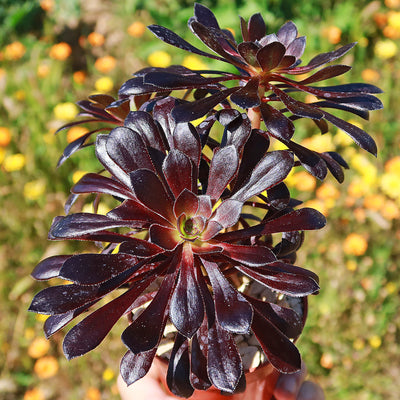
succulent with black flowers Black Rose
SKU: 88084025869
succulent with black flowers

succulent with black flowers Black Rose

Sale price$20.75 Regular price$23.05
Save 10%

Pay in installments of $5.76 with ShopPay, AfterPay and Klarna

Shipping Estimate
USA
  • USA
  • CAN

Ships within 48 hours · Estimated delivery Jul 3 - Jul 8

Promo Codes Available:

For Your Every Summer RSVP, with Code: SUMMER15

Description

succulent with black flowers Black RoseIntroducing the black rose, known as Aeonium Zwartkop', a beautiful variety of Aeonium arboreum. The name "Black Rose" comes from its leaves, which have a deep purple black tint that resembles roses. It is not a rose, but a succulent plant from the Crassulaceae family. The black rose Aeonium zwartkop has several other common names, such as Aeonium arboreum zwartkop, Aeonium black rose, purple crest aeonium, Aeonium 'black beauty', or tree aeonium.

Introducing the black rose, known as Aeonium Zwartkop', a beautiful variety of Aeonium arboreum. The name "Black Rose" comes from its leaves, which have a deep purple-black tint that resembles roses. It is not a rose, but a succulent plant from the Crassulaceae family.

The black rose Aeonium zwartkop has several other common names, such as Aeonium arboreum zwartkop, Aeonium black rose, purple crest aeonium, Aeonium 'black beauty', or tree aeonium. 

Hailing from the Canary Islands and reaching 5 feet in height and 3 feet in diameter at maturity, the black rose aeonium forms clumps and is sure to make a statement wherever it's planted.

When grown in full sun, the foliage takes on a deep, almost black color, which is why it's often referred to as the "Black Rose."

When grown in partial shade, the rosettes display a beautiful combination of purple-red hues with a green center. It's such a versatile plant that can add a touch of elegance and drama to any garden or succulent collection.

The flowers of Aeonium zwartkop bloom in the spring and produce clusters of small, yellow, star-shaped flowers that emerge from the center of its rosette-shaped foliage. The contrast between the dark purple-black leaves and the bright yellow flowers creates a stunning display. The flowers attract bees and other pollinators, adding life and movement to your garden.

Being a winter-growing plant, the Aeonium arboreum enters a state of dormancy during the scorching hot summer; during this time, the older leaves simply curl towards their points of growth rather than falling off entirely, giving the appearance of a black rosebud that is about to bloom. It's like a little garden masterpiece!

When and How to Water Your Black Rose  

From fall through spring, during its active growing season, Aeonium 'Black Rose' should be watered every 7–10 days, only when the top 1-2 inches of soil is completely dry. This is when the plant is most active, producing new leaves and expanding its rosettes. If under-watered during the growing season, you may notice the stems shriveling and leaves slightly puckering, but they'll quickly bounce back once hydrated.

In the summer months, when the plant enters dormancy, watering is reduced drastically to every 2–4 weeks or less. Aeonium 'Black Rose' naturally slows its growth or temporarily halts it during hot summer weather, especially in warmer zones or indoor conditions.

The plant conserves moisture during this rest period, so watering too often can lead to leaf drop or root problems. Only water if the plant begins to look overly stressed or if the soil has been dry for a prolonged time, again, always check at least two inches deep before watering.

Light Requirements - Where to Place Your Black Rose Succulent 

When growing the black rose succulent indoors, it's important to provide it with bright, indirect light for at least 4-6 hours a day. Keeping it in a well-lit area will help maintain the deep coloration of its leaves and promote healthy growth.

When grown outdoors, the black rose aeonium thrives in full sun to partial shade. In full sun, the foliage of this succulent turns almost black, which is why it's often referred to as the "Black Rose."

The intense sunlight brings out the deepest coloration in its leaves, creating a striking visual contrast. However, if you prefer a different look, placing it in partial shade will result in rosettes that display purple-reddish hues with a green center.

Remember, if your Aeonium 'Zwartkop' is exposed to too much direct sunlight and is not used to it, then there is a chance that the leaves might get damaged. It's critical to remember that during a heatwave or periods of extreme heat, your black rose succulent can get sunburned. You can protect the plant in this situation by moving it indoors or to a shaded area.

Optimal Soil & Fertilizer Needs 

The Aeonium zwartkop prefers sandy, well-drained soil, as excess moisture can promote root and stem rot. Planting them in ordinary soil will result in compacted roots, stunted growth, and most likely root rot. Instead, make or buy a well-draining potting mix, or ideally use our specialized succulent potting mix that contains 5 natural substrates and mycorrhizae to promote the development of a strong root system that helps your Aeonium succulent to thrive.

A small amount (5-10-5) of NPK fertilizer once a year in the spring will do wonders for your plant's health and growth. Using a natural fertilizer ensures that other beneficial compounds and microbes are added to the soil without the use of harsh chemicals. Show your succulent some love with awesome natural fertilizer and watch it thrive.  

Optimal Indoor Temperature & Humidity 

Aeonium 'Black Rose' thrives indoors at temperatures between 65–75°F with low to moderate humidity levels around 30–50%.

Keep your Aeonium away from cold drafts, heating vents, and sudden temperature changes. Place it near a bright window with indirect light, and ensure the space remains dry and airy to mimic its native Mediterranean-like climate.

Hardiness Zones & More

In the United States, this is mostly an indoor plant, but if you live in southern Florida or Hawaii, then you can cultivate it outdoors in USDA zones 9-12.

They are not cold- or frost-tolerant, you should plant them indoors or put them in a pot.

Move them indoors during the winter if you live outside of these regions. 

As for humidity, this succulent is adaptable and can tolerate average indoor humidity levels. However, it's important to provide good air circulation to prevent any issues with excessive moisture or stagnant air.

Wildlife - Black Rose Succulent Attracts the Following Friendly Pollinators

The Black Rose Succulent is known to attract a variety of friendly pollinators such as bees, butterflies, and hummingbirds with its vibrant blooms and sweet nectar. These pollinators play a crucial role in the plant's reproduction process by transferring pollen from one flower to another, ultimately helping the succulent thrive and produce seeds.

Butterflies
Bees
Hummingbirds
Lady Bugs
Multi Pollinators
Other Birds

According to the ASPCA, the Black Rose Succulent is non-toxic to humans and pets. It is safe to touch and is a popular choice for indoor houseplants due to its unique appearance and low maintenance requirements.

How to Propagate Your Black Rose Succulent

To propagate the black rose aeonium, one common method is through stem cutting. Simply take a healthy stem from the mature plants, making sure it is at least a few inches long. Allow the cutting to dry for a few days to form a callus, which helps prevent rotting. Then, plant the cutting in well-draining soil and keep it lightly moist until roots develop. With minimal water and full sun exposure requirements, this perennial is perfect for those looking for a low-maintenance addition to their garden or indoor space.

Key Takeaways

  1. The Black Rose Succulentis famous for its dramatic, rosette-shaped foliage in deep burgundy to nearly black hues, making it a striking focal point in any garden or collection.
  2. In late winter to early spring, mature plants produce tall stalks with clusters of bright yellow, star-shaped flowers, creating a striking contrast against the dark foliage.
  3. Aeonium ‘Zwartkop’ is highly drought-tolerant, requiring minimal watering, making it an excellent choice for xeriscaping or low-maintenance gardening.
  4. This winter-growing perennial, enters dormancy during hot summers, with older leaves curling towards growth points, resembling a black rosebud about to bloom.

Final Thoughts

Overall, the Aeonium zwartkop (black rose) is a unique and elegant succulent that can be a great addition to any indoor or outdoor space. Its dark foliage adds elegance and can be easily cared for with bright, indirect light indoors or full sun to partial shade outdoors. Keep your black rose aeonium away from cold, drafty windows and air vents if you are growing them indoors in a cold climate. The plant's distinctive black foliage or vibrant purple-reddish hues make it a standout in any garden or indoor decor. Its rosette-shaped leaves and compact growth habit add visual interest and can be a conversation starter.  

Be sure to add the ‘Aeonium arboreum ‘Zwartkop’ (black rose succulent) to your collection today and elevate the beauty of your home or garden, with this stunning-looking plant. 

Shipping Notes
  • Free Standard Shipping on $100+ Orders to the USA.
  • Except Preorder products are shipped in 48 hours.
  • Delivery to the USA:
  1. Standard Shipping : 3-10 business days
  • If time is of the essence, please consider selecting expedited delivery for faster service.
Exchange/Return Notes
  • We offer a 30-day return/exchange service after receiving.
  • Final sale items are not eligible for returns or exchanges.
  • To process your return/exchange, please contact us at [email protected]
  • Please click here for more details>>> Return & Exchange Policy
SKU: 88084025869

Discover Niche Categories That Outsell succulent with black flowers

Top-Converting Item to Boost Your Average Order

4.3 ★★★★★
Based on 1051 reviews
Sort
Highest Rating
Newest First
Oldest First
Product Reviews
E
Verified Purchase
E. K. Byham
Bozeman, US
★★★★★ 5
An essential work in putting American history in perspective
Format: Hardcover
This is a great book. It is not a book for everyone, however. If you don't know the difference between the Pilgrims and the Puritans, and I don't mean just when they arrived, try something simpler. It is a fascinating read if you already have some knowledge. For example, had I not been familiar with Hudson River geography and history, I'm not sure I would have been able to follow Bailyn's account of New Netherland. Naturally, as in any history, the most interesting stories are those you haven't heard before. For me, that was the information about New Sweden; I even read that section first. What makes Bailyn's book great, however, is his ability to make one see material one already knows a great deal about in new ways. Although he never addressed this question per se, he helped me answer a question that has been on my mind for at least fifteen years, and on which I've done considerable research - why did the Puritans, who arrived in 1630 as staunch Presbyterians, deriding their Separatist/Congregationalist Pilgrim neighbors, declare themselves Congregationalists in 1648 in the Cambridge Platform? (In part, the answer Bailyn helped me surmise is simply that when two or three Puritans gathered together, they had at least four different theological positions. It was hard enough to reconcile them in a single congregation; a presbytery would have been impossible.) The book also caused me to reassess my whole viewpoint on early Connecticut, and I certainly came to appreciate the importance of John Winthrop, Jr. beyond his role there. It is amazing too that Bailyn covers such a wide range of issues while devoting relatively few pages to each. The review in The New York Times Book Review, at least as I recall it, was wrong. While that reviewer praised the Virginia, Maryland and New Sweden/New Netherland portions, the New England portion (about 40% of the book) was dismissed as being only of interest to genealogists. While it is true that the earlier sections were more reflective of the book's subtitle, "The Conflict of Civilizations," the New England section would be of interest to a rather small portion of the genealogical community. (For example, I learned nothing new about my only ancestor discussed in the book, William Vassall.) I doubt if that reviewer has ever seen an on-line genealogy, which frequently contain claims such as that so and so was born in 1585 in the United States. As I have already said, the New England section, like the rest of the book, does a marvelous job of putting information in perspective; something that anyone interested in history needs to do.
WAS THIS REVIEW HELPFUL?YesReportShare
Reviewed in the United States on July 10, 2013
L
Verified Purchase
LPThomas
Pawtucket, US
★★★★★ 4
Interesting and important book
Format: Hardcover
This book looks at the motivations and demographics of the first wave of English immigrants to flee to what was to become the USA. Interestingly written, it explores the educations, positions of and the relationships of the earliest settlers to our east coast. I read it while researching our Family Tree and finding the people connected before coming, and for generations after. The endless Indian wars were a revelation, as was the tale of the oppressed becoming the oppressors as Quaker families fled Massachusetts for New Netherlands.
WAS THIS REVIEW HELPFUL?YesReportShare
Reviewed in the United States on March 9, 2013
R
Verified Purchase
RobCargill
Fort Morgan, US
★★★★★ 5
The Barbarous Years: The Peopling of British North America: The Conflict of... Bernard Bailyn
Format: Hardcover
A remarkable book!!! I have never read such a comprehensive book on early United States history that contained so much information I had never read before. How the status of "indentured servant" existed alongside the origins of slavery in Virginia and Maryland (along the Chesapeake Bay) was both remarkable and horrible. That a white man (typically, landowner) could have a child with a (black) slave who would become a free person at adulthood (earliest laws) created problems (they needed the "help"), so this law of the 1650s-1660s was changed! And if a white (free) woman had a child with a (black) slave, the resulting child would remain a slave! Matrilineal or patrilineal human rights, that is the question. Indentured servant, but with no expiration date. I had never before read how people in this country were real "pioneers" in the creation of slavery - at least with slavery of humans captured from the continent of Africa! It seems that whatever voices of "Christian" decency there might have been at the time - church based values or ones simply based in the hearts of people living here - they were drowned out by commercial interests or those who simply couldn't be bothered by such concerns. I hope you read this book and recommend it to your friends! Sincerely, Bob Cargill, Minneapolis
WAS THIS REVIEW HELPFUL?YesReportShare
Reviewed in the United States on April 19, 2013
K
Verified Purchase
k
West Palm Beach, US
★★★★★ 3
A decent primer -- no more.
Format: Hardcover
This is an odd book for one of America's premier historians. It isn't a bad book -- a person of Bailyn's erudition couldn't write a bad book -- but it doesn't hang together well. The author does not really have anything new to say and a historian of the Early Colonial Period will quickly recognize the usual sources. It is hard to see exactly what historiographical niche this book fills. Even the title is misleading. Sure, Jamestown was barbarous enough by our standards and New Amsterdam was plenty harsh. But, the Bay Colony was, by the rough-and-ready standards of 17th century Europe, pretty civilized. (Compare it with the contemporaneous English Civil War or the Thirty Years War.) As for "Conflict of Civilizations," there was certainly enough of that but the most interesting part of the book, the last third or so on the Bay Colony, is largely an account of Puritan theological quarrels. In fact, one senses that Bailyn felt like he was "home" when he wrote about the Bay Colony. He has, after all, written about New England since 1955 ("Merchants.") He gives the reader a clear account of the theological duels between Winthrop, Cotton, Hooker, Williams, Hutchinson and others. But, others have done this as well or better. Bailyn all but ties himself in a knot to be politically correct toward the Native Americans. For every Indian atrocity he finds a matching atrocity in European civilization. Still, if captured in war one was likely to be a lot better off among the English, French or Dutch than the Pequods. A LOT better off! This volume is part of a series that explores the settling of North America and hardly anyone is better equipped for this than the author. But, what begins as a good account of the horrors of Jamestown drifts into a twice-told tale of the niceties of Puritan disputation. It is almost as if Bailyn got bored half-way through and started channeling Perry Miller. A good book in its way and quite useful for an upper division course or first-year graduate seminar. But, not well-written enough to snare the casual reader and not original enough to snare the professional historian. An odd number.
WAS THIS REVIEW HELPFUL?YesReportShare
Reviewed in the United States on February 19, 2013
G
Verified Purchase
Goldry Bluzco
San Leandro, US
★★★★★ 5
Sheds Light On A Dimly Perceived Period
Format: Kindle
This book is clearly intended for those of us (non-historians) curious about what is a dimly perceived period of North American colonial history. Living as I do in Tidewater Virginia, I consider myself fairly well versed with the earliest years of English settlement or invasion, depending on your point of view. But, I was wrong. I had, of course, read about the wretched first two years of the Jamestown enterprise, but I had no idea just how ghastly the conditions of the first twenty years of the English colonial period were. Wave after wave of newcomers simply starved or died of disease in those years. The mortality rate was shocking. So many people were dying off that the local Indians did not even think it necessary to kill these newcomers (which proved a mistake, of course). And this was not just at Jamestown. For example, the author says that in any given year in one county 30 to 40% of the children under the age of eight were orphans. And the origins of many of these earliest colonists -- orphans dumped by local churches, beggars snatched off of urban streets, prisoners marched from gaol to waiting ships, many poor people literally kidnapped or tricked into emigrating -- was eye-opening. Talk about the refuse of British society. (As an aside, anyone whose humble immigrant ancestors came to Virginia in those years can forget about doing any genealogical research. You will never find the answers to your questions.) This does tend to be a bleak read. One of the things that jumped out at me was the sad, repetitive tale of European-Indian relations. It mattered not where one was. Virginia, Maryland, Delaware, New Amsterdam, New York, the pattern is always the same. Trade and early friendly relations were quickly undermined by misunderstandings, stupidity, devious tricks, alcohol, and land disputes that led to attack and counter attack and massacres on both sides. One of the things I did enjoy was the Indians' views of Christianity. Those mentioned by the author viewed it as little more than a strange dream. When the concept of a universal god was explained to them they laughed and called it a silly fable. I can only agree. My respect for their powers of reasoning and perspicacity rose immeasurably. Just who was the savage?
WAS THIS REVIEW HELPFUL?YesReportShare
Reviewed in the United States on July 30, 2013

recommand products